1. Global Commercial Park Swings Industry: Macro Economic & Sourcing Dynamics
In the modern urban planning and recreational development landscape, public park swings represent one of the highest ROI capital investments for municipal authorities, commercial real-estate developers, and education providers. According to global amusement market data, non-powered play equipment—specifically commercial swing systems—accounts for over 34% of total daily interactions in municipal playgrounds. However, procurement officers and B2B buyers frequently confront a structural paradox when querying for "cheap park swings suppliers & factory" options: how to reconcile budget constraints with stringent international safety certifications and long-term structural durability.
The term "cheap" in commercial procurement must be critically redefined. True economic value is achieved not through sacrificing material density or structural safety factors, but through direct-from-factory procurement models, streamlined OEM/ODM manufacturing, and advanced metallurgical engineering. When sourcing from established manufacturing hubs like Leisure Playground Toys (Shanghai) Co., Ltd. (established in 2008), buyers eliminate middle-tier broker margins (often markup rates between 40% to 120%) while gaining direct access to certified heavy-duty steel frameworks and custom ergonomics.
Industry trends indicate a rapid shift toward inclusive, multi-generational swing systems. Procurement teams are moving away from residential-grade light tubular frames toward heavy-wall hot-dip galvanized steel (Q235B grade) coated with thermosetting powder finishes capable of enduring harsh coastal salt-spray environments and high UV indexes without chalking or structural delamination.
2. Metallurgy, Polymer Science & Anti-Vandal Engineering
To evaluate factory capabilities when procuring cost-effective commercial park swings, B2B buyers must inspect the structural anatomy and material specification sheets. Lowering capital expenditure without sacrificing structural integrity relies on optimized production processes, precision CNC plasma cutting, and automated robotic welding.
Structural Frame Metallurgy
Factory-direct frames utilize Schedule 40 Q235B structural carbon steel tubing (OD 114mm with a 3.0mm to 4.0mm wall thickness). Steel structures undergo hot-dip galvanization inside and out, followed by a multi-stage shot-blasting process and AkzoNobel electrostatically applied UV-resistant powder coat (100–120 micron thickness).
Bearing & Hanger Assemblies
Swivel connections feature 304 or 316 grade investment-cast stainless steel housing with self-lubricating bronze or sealed oil-impregnated ball bearings. This ensures frictionless 360-degree rotation, minimizes mechanical squeaking, and prevents metal-on-metal wear that causes premature fatigue failure.
Seat & Suspension Polymeric Materials
Seat solutions combine EPDM synthetic rubber encapsulating a high-tensile steel core insert (preventing vandalism and cutting) or rotational-molded LLDPE plastics with UV-8 stabilization ratings. Suspension options include short-link stainless steel chains or plastisol-dipped galvanized chains to eliminate finger entrapment.
3. Regulatory Compliance: EN1176 (Europe) vs ASTM F1487 (USA) Matrix
A primary factor that separates reputable playground swing factories from uncertified producers is strict adherence to international safety parameters. When sourcing low-cost commercial swings, understanding the nuances between EN 1176-2 (European Standard for Swings) and ASTM F1487-21 / CPSC (North American Standard) is critical for compliance and insurance risk mitigation.
| Safety Criterion | EN 1176 Standard (European Union) | ASTM F1487 / CPSC (North America) | Leisure Playground Factory Implementation |
|---|---|---|---|
| Ground Clearance (Rest) | Min. 400 mm for heavy seats; 350 mm for flexible seats | Min. 12 inches (305 mm) above surfacing material | Factory adjustable chain links; preset to 420 mm safety margin |
| Minimum Seat Distance | Calculated via formula: $S = 0.20 + 0.04h$ (Min 450mm) | Min. 24 inches (610 mm) between adjacent seats | Standardized 650 mm spacing on multi-bay A-frames |
| Impact Attenuation (HIC) | Seat mass & flexibility must pass HIC acceleration testing | Impact testing on seat edge per ASTM F1487 guidelines | Aluminum-insert EPDM seats with energy-absorbing bumper borders |
| Finger Entrapment Zone | Probes tested between 8 mm and 25 mm gap clearances | No open loops or S-hooks allowing 0.13-inch probe entry | Fully enclosed 304 stainless steel clevises & shackle connectors |
| Structural Load Factor | Dynamic load testing up to 3x maximum user capacity | Static load test of 750 lbs (340 kg) per swing position | 100% factory batch tested to 400 kg dynamic load per bay |
Quality swing manufacturers design swing frames using modular, universally compliant dimensions. This allows municipal buyers in North America, Europe, the Middle East, and Australia to deploy factory-direct products that pass local field safety audits effortlessly.
4. Commercial Swing Typology & Total Cost of Ownership (TCO) Analysis
Selecting the correct swing system configuration depends on site capacity requirements, user demographics, and long-term maintenance budgets. Below is an engineering comparison evaluating capital expenditure (CapEx) against expected lifecycle maintenance costs (OpEx).
| Swing Frame Type | Ideal Application Scenario | Vandal Resistance | Capacity / Hour | Relative CapEx Rating | Estimated Lifespan |
|---|---|---|---|---|---|
| Standard A-Frame (2-Bay / 4-Seat) | Public Municipal Parks & Schools | High (EPDM Steel-Core) | 120 Users/hr | Economy ($) | 15–20 Years |
| Single-Post Cantilever Swings | Modern Architectural Plazas & Resorts | Very High | 60 Users/hr | Moderate ($$) | 20+ Years |
| Inclusive Basket / Nest Swings | Inclusive Playgrounds & Therapy Centers | High (Reinforced Rope Mesh) | 180 Users/hr (Group) | Moderate ($$) | 12–15 Years |
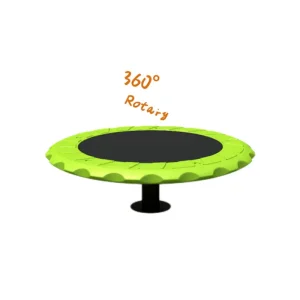
| 360° Rotational T-Swing | Urban Plazas & High-Traffic Centers | Extreme (Heavy Duty Spindle) | 90 Users/hr | Premium ($$$) | 20+ Years |
| Parent-Infant Tandem Swings | Community Gardens & Family Resorts | High (Molded LLDPE) | 40 Users/hr | Economy ($) | 15 Years |
By evaluating the Total Cost of Ownership, factory-direct steel A-Frame swings yield the lowest cost-per-user ratio over a 15-year period. Direct factory purchasing allows operators to order redundant high-wear components (such as extra EPDM seats and bronze bushing assemblies) in the initial shipping container, minimizing operational downtime.
5. Localized Application Scenarios & Engineering Adaptations
Park swing installations must be custom-adapted to local geographic and environmental conditions. Factory customization plays a crucial role in preventing premature structural deterioration caused by climate stressors.
Coastal Marine Environments
High salinity and humidity accelerate galvanic corrosion. Factory adaptation requires upgrade to 316 marine-grade stainless steel hardware, double-pass zinc-rich primer coatings, and sealed bearing housings.
High UV Desert Zones
Intense solar radiation degrades standard plastics within 24 months. Factory engineering utilizes UV-16 stabilized compounded LLDPE resins and thermal-reflective powder finishes to prevent seat surface heating.
High-Density Urban Parks
Vandalism risk requires tamper-proof Torx security bolts, steel-reinforced EPDM seats, anti-wrap bearing assemblies, and concrete footings engineered for heavy continuous foot traffic.
School & Kindergarten Grounds
Focuses on age-segregated safety zones, lower critical fall height (CFH) impact surfacing, and ergonomic soft-touch toddler seats to build core balance and sensory coordination.
6. Technology Roadmap: Smart Sensor Systems & Circular Materials (2025–2030)
The commercial playground industry is undergoing a digital and environmental transformation. Smart city integration and circular manufacturing models are driving the next generation of park swings manufactured by industry leaders.
Kinematic IoT Usage Sensors
Integration of self-powered piezoelectric sensors within swing top-beams. These sensors log daily swing cycles, measure peak structural loads, and alert park management when maintenance intervals are reached, shifting from reactive to predictive upkeep.
Recycled Circular Polymers
Transitioning from virgin plastics to 100% ocean-bound recycled HDPE polymers for molded seats and decorative panels. This process lowers carbon footprints by up to 65% while maintaining structural impact strength and weather resistance.
Graphene-Enhanced Powders
Incorporation of nano-graphene additives into exterior powder coatings. This innovation dramatically enhances anti-scratch durability, provides superior corrosion protection in coastal regions, and repels graffiti paints.
7. Turnkey Procurement & OEM/ODM Manufacturing: Leisure Playground Shanghai
As an established leader in playground equipment manufacturing located in Songjiang, Shanghai, Leisure Playground Toys (Shanghai) Co., Ltd. operates a modern production facility dedicated to international market export. Offering end-to-end capabilities, the factory assists clients from initial CAD layout design to full container loading and after-sales support.
1. Custom CAD & 3D Renderings
In-house architectural designers generate free custom 2D spatial layouts and photorealistic 3D renderings tailored to site dimensions, terrain elevation, theme colors, and safety fall zones within 24–48 hours.
2. Three-Stage Quality Protocol
Every product undergoes raw material spectral analysis, pre-assembly structural trial fitting at the factory floor, and dynamic load testing prior to export packaging under ISO 9001 / 14001 / 45001 management protocols.
3. Door-to-Door Logistics & Support
Full container ocean shipping to over 80 countries with comprehensive installation manuals, step-by-step foundation bolt drawings, and dedicated remote video support from senior installation engineers.
8. Frequently Asked Questions (FAQ) for Commercial Buyers