Commercial Water & Indoor Play Featured Catalog
Precision-Engineered Modular Play Components Direct from Shanghai Manufacturing Facility
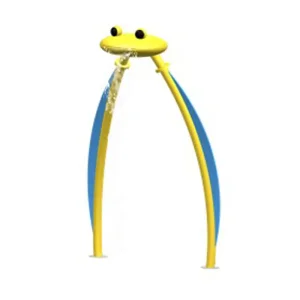
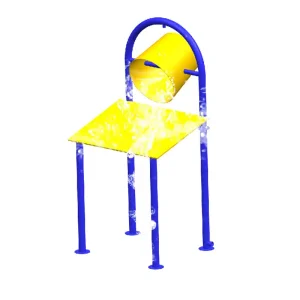
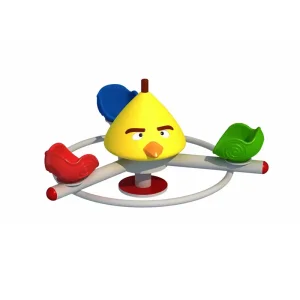
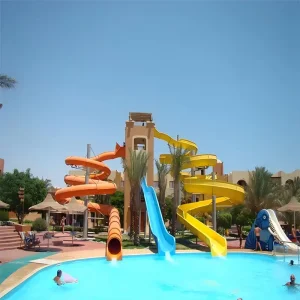
Global B2B Market Dynamics: The Indoor Play Sector Evolution
Analytical Insight into Commercial Indoor Slide Sourcing, Structural Design Demand, and Commercial Footfall Optimization
The global market for commercial indoor entertainment, Family Entertainment Centers (FECs), mega retail centers, and indoor waterparks is undergoing a structural transformation. Procurement teams, architectural consultants, and resort operators are increasingly moving away from off-the-shelf catalog products toward custom OEM indoor slide manufacturing. Driven by the need to maximize square-meter yield, comply with evolving international safety codes, and create high-margin photo-ready architectural anchors, commercial buyers now demand factory-direct engineering expertise.
According to recent industry benchmarks, indoor amusement and active-play centers are projected to sustain a CAGR exceeding 6.8% globally through 2030. Key growth vectors include suburban urban commercial hubs, indoor climate-controlled waterparks in Northern Europe and North America, and multi-tier indoor play zones within Middle Eastern luxury shopping malls. In this high-density environment, indoor slides serve as essential vertical circulation assets that encourage family dwell time, drive recurring membership sales, and generate measurable asset value.
High Spatial Efficiency
Custom OEM manufacturing allows slides to wrap around structural pillars, integrate into existing mezzanines, and utilize vertical building voids without requiring structural building modifications.
Zero-Climate Vulnerability
Indoor installations eliminate weather downtime, UV degradation, and seasonal closures, providing commercial venue operators with stable, 365-day annual cash flows.
Architectural Customization
OEM factories offer tailored RAL color matching, gel-coat flame retardancy, translucent fiberglass sections, and integrated LED light-chasing modules for interactive visual appeal.
Engineering Architecture & Material Science Standardisation
Comparative Analysis of Industrial-Grade Polymers, Structural Steel Fabrication, and Safety Ergonomics
Selecting the correct material matrix for indoor commercial slides directly impacts structural lifespan, total cost of ownership (TCO), maintenance overhead, and user safety. As a primary OEM manufacturer based in Songjiang, Shanghai, Leisure Playground Toys utilizes strict physical metallurgy and polymer chemistry standards across all custom orders.
1. Fiberglass Reinforced Plastic (FRP) vs. Rotomolded LLDPE
For high-throughput indoor environments and multi-story spiral drops, Fiberglass Reinforced Plastic (FRP) engineered via Resin Transfer Molding (RTM) represents the industry gold standard. RTM FRP components feature dual-smooth gel-coat surfaces, uniform structural thickness, and exceptional tensile strength exceeding 120 MPa. Alternatively, linear low-density polyethylene (LLDPE) manufactured via rotational molding provides superior cost-performance ratios for toddler-focused modular play zones.
| Engineering Property | Resin Transfer Molded (RTM) FRP | Rotomolded LLDPE Polymer | AISI 304 / 316 Stainless Steel |
|---|---|---|---|
| Tensile Strength (MPa) | 120 – 250 MPa | 15 – 25 MPa | 515 – 620 MPa |
| Fire Retardancy Rating | Class B-s1, d0 (EN 13501-1) / UL94-V0 | UL94-HB (Additives required) | Non-Combustible (Class A1) |
| Surface Gel-Coat / Finish | Isophthalic Neopentyl Glycol (ISO-NPG) | Raw Mold Finish / Anti-Static Coating | Mirror Polish / Hairline Brushed |
| Commercial Dwell Life | 15+ Years (Heavy Commercial Use) | 7 - 10 Years (Medium Commercial) | 25+ Years (Extreme Traffic) |
| Optimal Venue Placement | Multi-level FECs, Indoor Aquaparks | Kindergartens, Mall Toddler Hubs | High-End Architectural Plazas |
Engineering Assurance Note: All OEM structural steel supports manufactured by Leisure Playground undergo hot-dip galvanization (min 80μm zinc coating thickness) and thermosetting polyester powder coating. This prevents internal oxidation and guarantees structural stability under heavy mechanical dynamic loads.
2. Ergonomics, Velocity Dynamics, and Impact Attenuation
Indoor slide design requires precise mathematical modeling of rider deceleration profiles. OEM slide geometries engineered by our R&D teams utilize Finite Element Analysis (FEA) to verify g-force thresholds, rider trajectory predictability, and exit zone velocity vectors. By standardizing slide incline profiles between 28° and 35°, our equipment ensures high adrenaline throughput while preventing rider airborne incidents or tailbone impact injuries.
Industrial Scalability & OEM Production Rigor
Quantifiable Manufacturing Footprint Backed by Advanced Quality Assurance Protocols
Operating out of our Songjiang, Shanghai manufacturing hub, Leisure Playground Toys operates a vertically integrated production line spanning 3D CAD modeling, custom FRP mold fabrication, CNC steel pipe bending, robotic TIG welding, and automated powder coating lines. Our facility complies fully with ISO 9001:2015 Quality Management Systems, ISO 14001:2015 Environmental Management Systems, and ISO 45001:2018 Occupational Health & Safety Systems.
Turnkey OEM/ODM Engineering Workflow
From Initial BIM/CAD Conceptualization to Site Assembly and Quality Certification
Phase 1: Spatial & BIM Modeling
Clients submit site dimensions, architectural CAD files, or 3D REVIT models. Our structural engineers produce customized 2D/3D layout proposals matching age demographics, ceiling clearance, and exit safety margins.
Phase 2: Precision Tooling & Fabrication
Upon design sign-off, high-precision steel molds or CNC polymer cutting programs are initiated. Material formulations include flame retardants, anti-microbial agents, and UV stabilizers engineered for longevity.
Phase 3: Pre-Assembly & Quality Audits
Prior to global packaging, every indoor slide structure undergoes full trial assembly inside our Shanghai factory to verify seam alignment, flange bolt torque tolerance, structural rigidity, and surface smoothness.
Extended OEM/ODM Water & Indoor Play Equipment Range
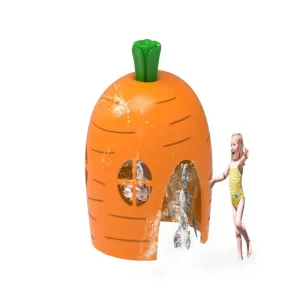
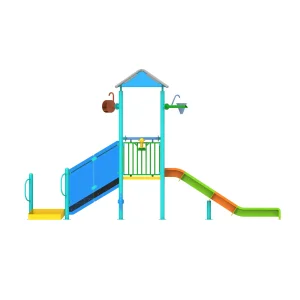
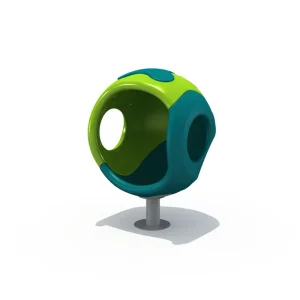
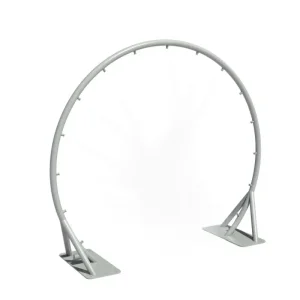
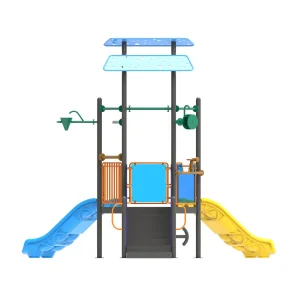
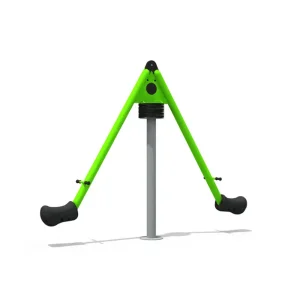
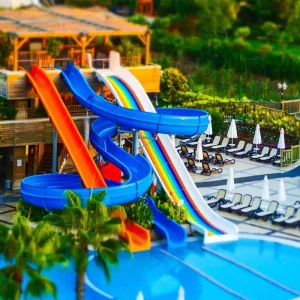
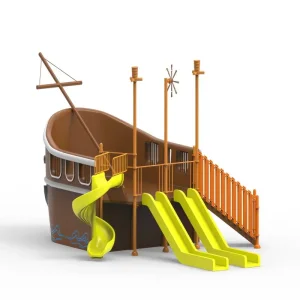
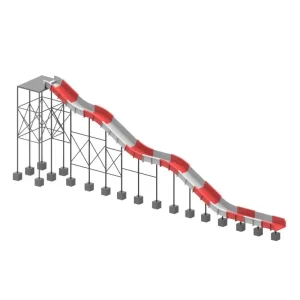
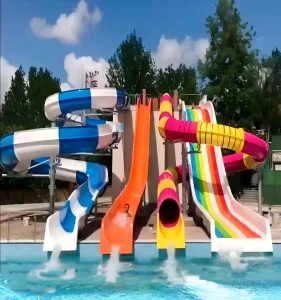
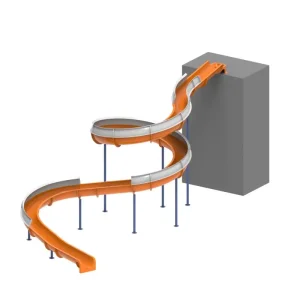
Commercial-Grade Water Slides, Spray Architecture, and Interactive Swivel Features
Global Compliance Standards & Regional Safety Frameworks
Architectural Certification Readiness for North American, European, and Middle Eastern Jurisdictions
Installing commercial indoor slides requires absolute adherence to strict regional safety laws. Leisure Playground Toys engineers all OEM slide equipment to meet or exceed regional structural, flammability, toxicity, and impact safety directives:
- European Union (EN 1176 / EN 1177 / EN 13501-1): Full compliance with EN 1176 playground equipment safety criteria, including head/neck entrapment protection, finger impalement prevention, and EN 13501-1 Class B-s1, d0 flame propagation resistance for enclosed indoor spaces.
- North America (ASTM F1487 / CPSC / ADA): Compliant with ASTM F1487 standards for public playground equipment, incorporating ADA-compliant access ramps, impact-absorbing fall zones, and non-toxic heavy-metal-free polymer coatings.
- Middle East & Asia-Pacific (SASO / AS 3533): Structural integrity engineered to resist extreme thermal expansion in indoor glass atrium environments, compliant with SASO quality standards and Australian AS 3533 amusement ride guidelines.
Frequently Asked Questions by Commercial Procurement Teams
Expert Answers Regarding OEM Customization, Lead Times, Shipping Logistics, and On-Site Installation